
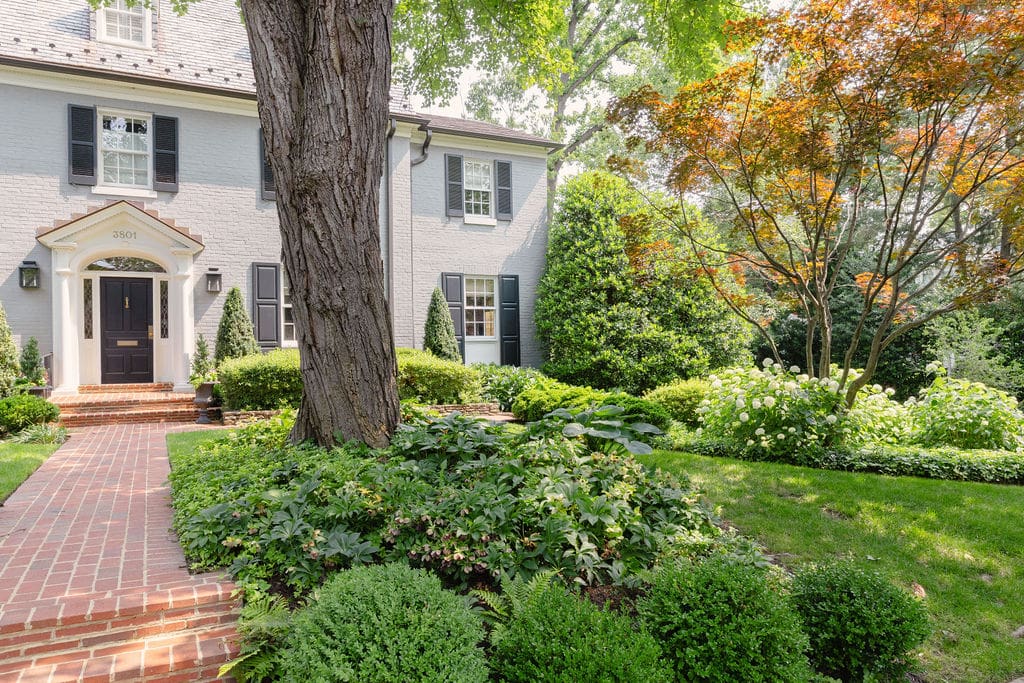
Long before anyone rings your doorbell, they’ve probably already formed an impression of your home. It happens on the street as they pass by in a car, on the sidewalk, and on the walk up the front path in the steps between the street and the porch.
A well-designed exterior entryway can help people feel welcome, know that someone cares about this place, and that they’re about to walk into somewhere comfortable.
I spend a lot of time on front yards in Bethesda and the surrounding DC neighborhoods, and the homes that feel the most inviting almost never rely on one big gesture. They get there through a handful of thoughtful landscape and hardscape decisions that work together, guiding you from the curb to the front door.
My Tips for Creating a Welcoming Exterior Entryway
1. Start at the Sidewalk, Not the Door
Most people think about their entryway as the porch and the door. I think about it as the entire journey.
The moment someone steps off the sidewalk or out of the car, your landscape should be doing some work to point the way, slow people down, and give them something pleasant to look at.
In Bethesda, where many lots are mature and tree-lined with homes sitting fairly close to the street, that journey can be short, which means every detail counts.
A clear transition from public sidewalk to private property, whether that’s a change in paving, a pair of planted beds, or a low hedge, can give the sense of arrival even on a compact lot.
2. Make the Path Obvious and Generous
A walkway is the backbone of your exterior entryway, and it should feel effortless to follow. If a visitor ever hesitates about where to go, the design isn’t doing its job.
A few things I look for when designing entry walkways:
- Width: A path of roughly four feet allows two people to walk side by side comfortably, which makes a big difference for guests, strollers, and groceries.
- Material: Bluestone, flagstone, natural stone pavers, and brick all suit the character of DC area homes, and each one brings a different personality. Permeable options can also help manage runoff, which matters on many Bethesda properties.
- Shape: A gentle curve can feel relaxed and garden-like, while a straight path suits a more formal home. The right answer depends on the house and the lot, not a trend.
- Directness: Paths that follow the way people actually want to walk get used. Paths that force an awkward detour tend to get cut across.
3. Let the Porch Do Its Part
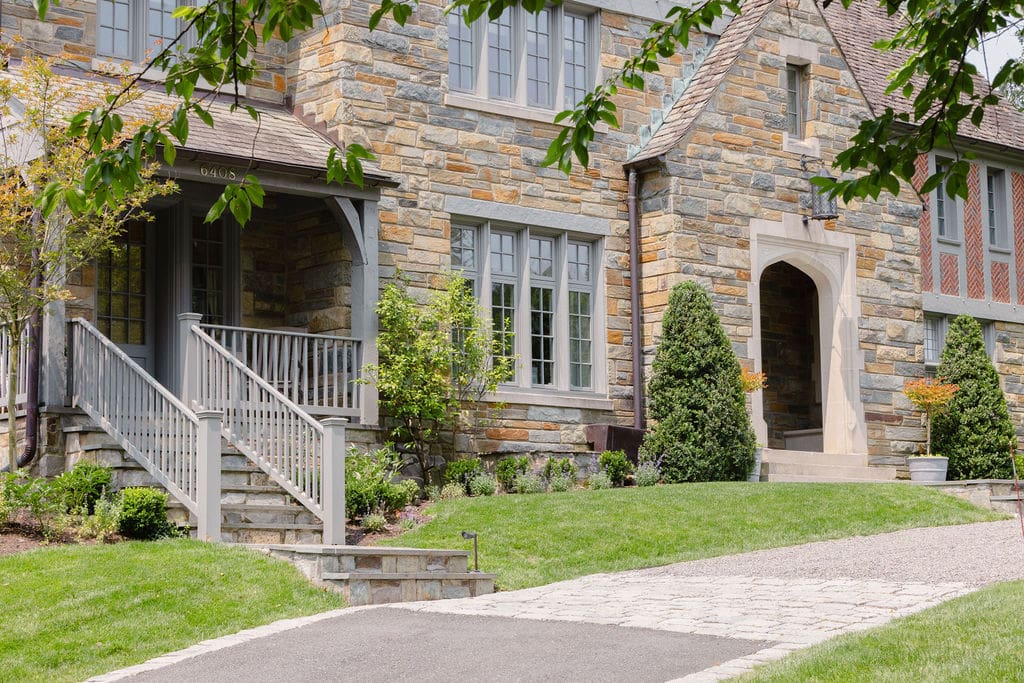
The front porch is where your entryway finally lands, so it deserves as much thought as the path leading to it.
Steps should feel solid and proportionate, with treads deep enough to be comfortable. A landing with enough room to stand, set down a package, or greet someone makes the door can help your home feel like a warm welcome instead of an afterthought.
This is also where containers or plants that frame your entryway can earn their place. A pair of planters flanking the door adds symmetry and color, and a few seasonal changes through the year keep the entry feeling fresh. Evergreens like boxwood or dwarf conifers give structure in winter, while spring bulbs and summer annuals bring in color when you want it.
4. Plant to Frame, Not to Hide
Plantings along an entryway should frame the path and the door without crowding either one. I like to build layers: low, tidy plants nearest the walkway, medium shrubs behind them, and taller specimens or small ornamental trees at the corners of the house or the edges of the bed.
Some reliable choices for Bethesda area entryways include:
- Boxwood and inkberry holly for evergreen structure
- Panicle and oakleaf hydrangea for summer and fall interest
- Japanese forest grass and hellebores for shadier front yards
- Catmint, sedum, and native grasses for sunnier beds that need less water
- Serviceberry or Japanese maple as a small tree that offers something in every season
Planting for all four seasons matters here. An entry that looks wonderful in June and bare in January misses a lot of the year, and in this region we have plenty of gray months where a little green and a bit of structure go a long way.
5. Light the Way
Lighting is one of the most overlooked parts of an exterior entryway, and it changes how a home feels after dark.
Low-voltage path lights, soft uplighting on a favorite tree, and a well-placed light at the door make the approach safer and far more welcoming. The goal is a warm glow that guides people, not a bright wash that feels like a parking lot.
6. Keep It Personal
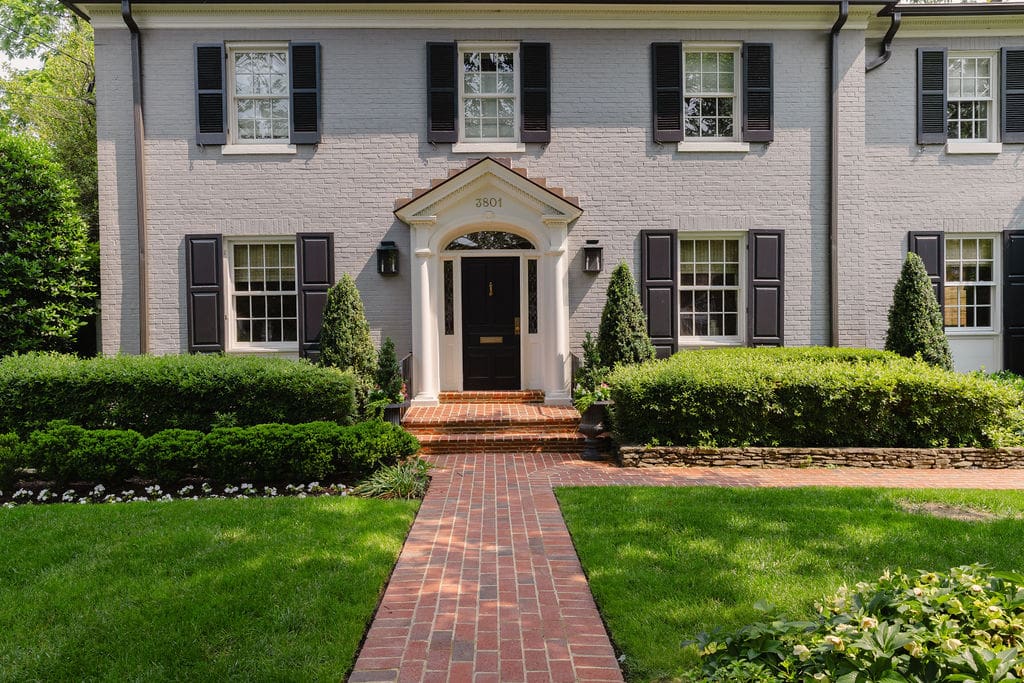
The best entryways feel like they belong to the people who live there. A bench to set a bag on, a collection of pots you’ve gathered over the years, a plant you love because your grandmother grew it.
These are the details that turn a nice front yard into a welcoming one, and good design leaves room for them.
Ready to Rethink Your Entryway?
At Lanier Landscapes, I work with homeowners across Bethesda, Chevy Chase, and the greater DC area to design front yards that feel gracious from the very first step. If you’re ready to create an exterior entryway that welcomes people before they ever reach your door, reach out and let’s talk about what your home deserves.

I’m a Chevy Chase, DC-area landscape designer with 3 kids and 2 dogs that always keep me on my toes. Nature has always been a part of my life and as a child, I spent countless hours in the garden alongside my mother, learning the rhythm of the seasons and the joy of nurturing a living space. Now, I continue to find inspiration in the beauty of nature.
I founded Lanier Landscapes in 2013 after noticing how many outdoor spaces felt impersonal — beautiful but lacking warmth, functional but uninspired. I’m here to help you create an outdoor space that you can’t wait to come home to.
